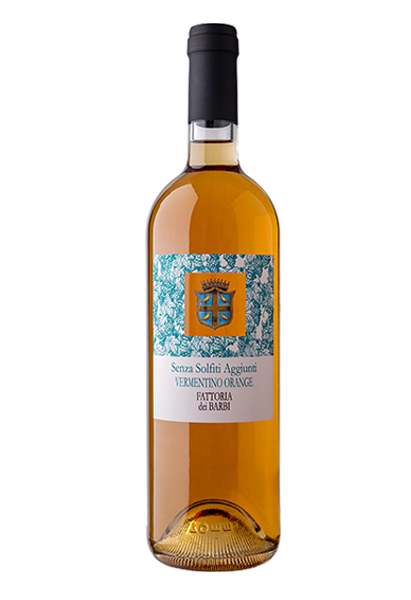
Vermentino Orange IGT Toscana bianco 2024
BIO | Senza Solfiti Aggiunti

Tuscany, Toscana

White Wine

Vermentino

Sustainable

750 mL
BIO Line – No Added Sulfites
The wines in our BIO “No Added Sulfites” line come from vineyards in the Maremma region, where the dry climate allows for perfectly healthy grapes — essential for producing wines without sulfites. The grapes are organically farmed and certified under the VIVA protocol by the Italian Ministry of the Environment.
Vermentino Orange – Toscana IGT White | Organic | No Added Sulfites
This “No Added Sulfites” Vermentino is a pure expression of the grape, made using the latest technology and the highest hygienic standards — but without the use of chemical additives.
How is it made? Three days of skin contact, fermentation with selected yeasts that reduce even the naturally occurring sulfites, and three months on fine lees to naturally enhance aromatic complexity and stability.
The result? An explosion of aromas, flavor, and lasting pleasure on the palate.
Its naturally golden hue inspired the name: “Orange.”
Tasting Notes:
Color: deep antique gold with amber reflections.
Aroma: intense and varietal, with floral notes of Mediterranean scrub (sage, broom), candied fruit, dried apricot, honey, and saffron.
Palate: enveloping and velvety, vibrant and savory with a long-lasting finish.
Food Pairings:
Best with dishes that are not overly elaborate or complex, such as seafood starters, baked or poached fish, octopus, shellfish, vegetable pies, lean meat dishes, or cheese ravioli. Ideal as an aperitif and with soft cheeses.
Aging Potential: up to 2 years
Bottle Storage: Store lying down, in the dark, at a stable temperature of 12°–14°C.
Vintage: 2024
Designation: Toscana IGT
Grape Variety: 100% Organic Vermentino
Alcohol: 14%
Format: 0.75 L
Serving Temperature: 8°–10°C
Type: White
Vinification and Aging:
The grapes were hand-harvested at peak ripeness. The clusters are gently destemmed and crushed without breaking the skins, to enhance contact between juice and skins. The must is then placed into fermentation tanks at a constant temperature of 20°C, where alcoholic fermentation begins. The extended maceration—prolonged contact between skins and must—acts as a natural alternative to added SOâ‚‚ and enables the extraction of aromatic compounds and polyphenols. This process also intensifies the wine’s golden hue. After approximately 4 days, the wine is racked and alcoholic fermentation continues at 20°C until complete sugar depletion. Malolactic fermentation follows, reducing acidity and adding roundness. The wine rests on fine lees for around three months, enhancing complexity, richness, and volume while improving the overall mouthfeel.
 in your url address bar to continue.